

These days lots of buzz words are thrown around in relation to sustainability. Businesses are increasingly claiming that their offerings are sustainable, organic, eco-friendly, ethical and locally made. With this influx of terms, how do we begin to think about what really makes up a sustainable product? In this article, we help you unpack the various elements that make a sustainable product so that you can ask more questions as a conscious consumer.
It’s worth pausing here to think about definitions. Though there are many, we at Conscious Consumption think about sustainability as a state where the needs of all people are met, on a healthy planet (adapted from Kate Raworth’s definition). This is a state that we all need to continuously work towards. As conscious consumers we need to think about how our everyday purchasing decisions affect people and the planet. What we often forget is that everything we buy and use was extracted, created, and distributed to us by people, and used natural resources. By being more selective about what we buy, we have a little influence over making those impacts positive.
Buying organic produce made by smallholder farmers is likely to have far more beneficial impacts for people and planet than buying from commercial farms that depend on chemicals and heavy machinery. Buying locally made, handcrafted items (such as a pair of shoes) might come at a higher upfront cost, but will outlive mass produced imported items because they are often better quality and repairable. The impacts from this might be more employment, the preservation of skills, and a reduced requirement on virgin natural materials.
Researching every product we buy as individuals is a daunting and exhausting task. That’s why we do it for you. We look for South African brands that we consider to be the leaders in sustainability and only list products made by companies that care for humanity and the planet, in addition to making excellent products. Thinking in terms of a product’s lifecycle can help us gain a more holistic view of sustainability because it gives us insight into the processes involved in making a product and where the associated social and environmental impacts of each process lie.
Lifecycle thinking helps us start asking important questions like what is the product made of, where is it made, who makes it, and how does it get disposed of? We unpack some of the questions we feel are important to ask below. While we might not be able to answer all these questions immediately, thinking in terms of a product’s lifecycle can help us uncover valuable information. We view the lifecycle of a common product as having five phases, as depicted and described below.
Visual representation of a product’s lifecycle
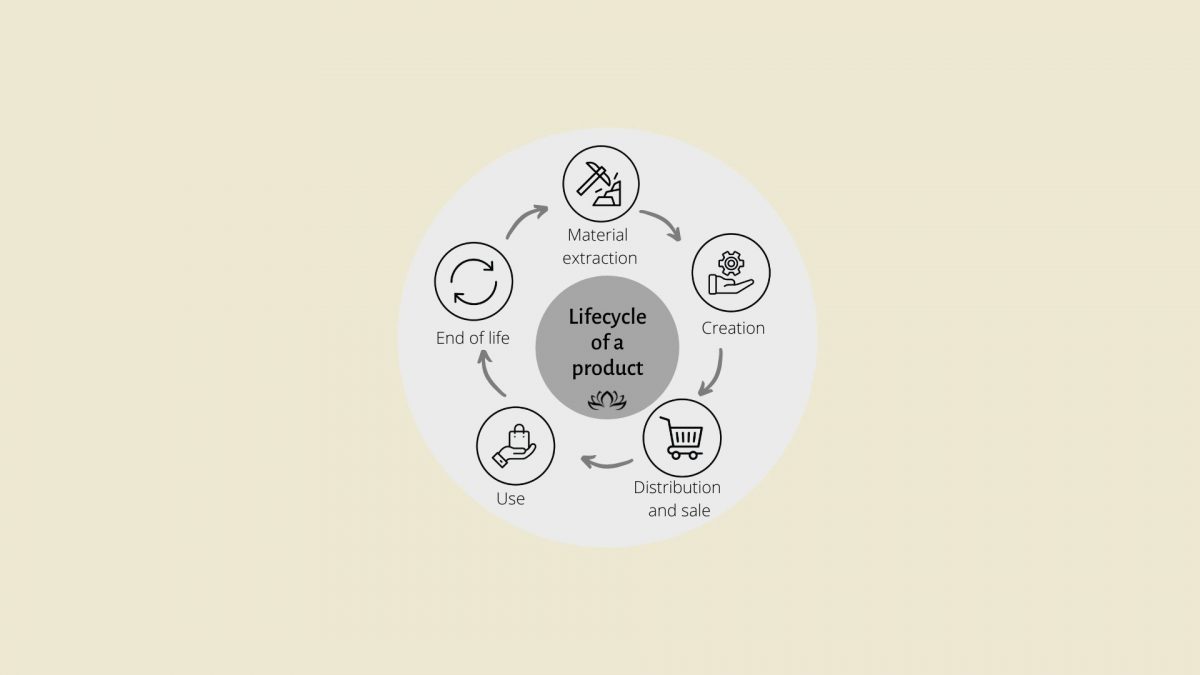
1. Material extraction
Most products are made from materials that come from the earth. What materials are used to make the product? Are they natural? Are they renewable? Where do the materials come from? How are those materials sourced? Are toxic substances used to grow or extract materials? What waste is produced from making the product? Are natural areas disturbed, and if so, will the area be rehabilitated? Are natural materials harvested at a rate that the earth can replenish? Information about the materials used in a product is particularly difficult to access in large global value chains, highlighting an important aspect of why local is indeed lekker. The importance of having control or at least insight across the value chain is made clear by this quote from them SOiL.
“Growing our plants organically means that no chemicals ie. pesticides or fertilizers are used. It has been proven that using these chemicals kills off micro-organisms in the soil, therefore reducing soil diversity. These chemicals also pollute our groundwater, killing off fish and marine life as well as polluting our drinking water. … It takes a great deal of plant material to create even a small amount of essential oil and due to the way that essential oils are produced; residues of pesticides in concentrated form may appear in the oil if not produced organically. Organic farming ensures that the end product is free of many of these residual toxins and results in a purer and more effective oil. This is comforting to know when you consider that 60% of what you put onto your skin is absorbed into your body!”
2. Creation
Once the input materials are ready it’s time for the product to be made. What inputs are required in the creation of the product? Is the product hand crafted or mechanically made? Where is the product made? What waste material is generated and what happens to that waste? Satori for example balances making components of their notebooks by hand with some mechanical help to keep costs down. Unlike their conventional alternatives which use paraffin and bleach, FireFly Firelighters and Güdco Toilet paper are made from non-toxic and waste materials.
3. Distribution and sale
Once the product is made it needs to be accessible to the customer. Relative to the rest of the value chain, retailers don’t ordinarily use many resources aside from electricity, water, and fuel. However, there are other opportunities for positive impact. As for example minimise our footprint by being conscious about our energy and water use, composting and recycling. We also offer a ‘slow shipping’ option and encourage our Cape Town based customers to opt for reduced packaging options. As far as possible we use recycled carboard boxes for deliveries and in the future we will extend our zero-packaging offering (e.g., by using reusable delivery boxes, offering replenishing options etc.). We will also continue to minimise our footprint, work with our suppliers and customers to make positive impact, and keep expanding our range of sustainably and locally made products.
4. Use
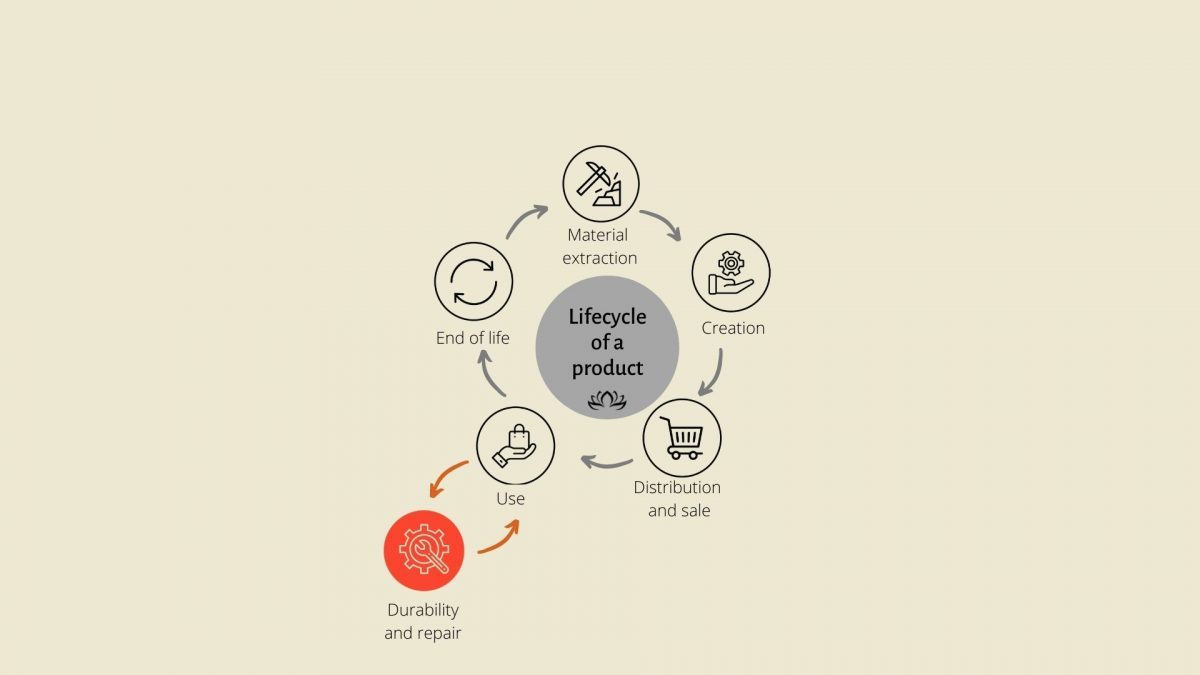
Even after a product is made and sold there are still impacts associated with it – it might need to be cleaned or refilled or maintained. For example, a significant amount of water and energy is used after a t-shirt has been made, during its use phase (washing, drying and ironing). In the case of a t-shirt, these impacts can be reduced by washing less frequently, washing with cold water, and line drying. Thought also needs to be given to the type of substances required during this phase. For example, a consumer could use biodegrade washing powder instead of more toxic conventional alternatives. A bicycle owner might seek secondhand parts to repair their bicycle instead of depending on new parts which more than likely would be made from virgin materials. A product’s useful life can be extended though regular servicing and maintenance. In the case of a t-shirt, it might mean doing minor repairs, or once it becomes worn, repurposing it for sports, garden, sleepwear etc.
Extending the useful life of a product
5. End of life
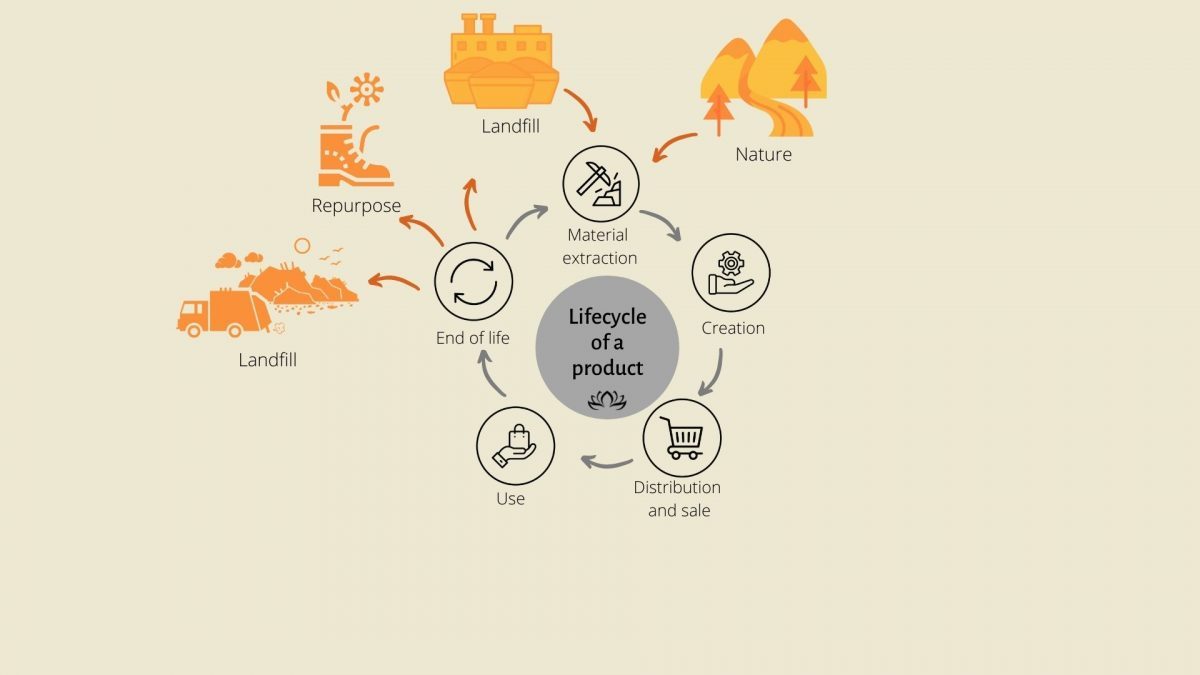
Once the product has reached the end of its useful life does it have to go to landfill? Can the items to taken apart and it’s component parts used in other applications, or can it be recycled or converted back to input materials for another process? Growing Paper uses waste material to create their cards, and embeds seeds into their products (bookmarks gift tags and other products or gift tag) so that when returned to the soil, seedlings grow from the paper. All of our products are selected based on the fact that they are made of natural materials so there are no chemical residues that remain at the end of its useful life, and most of our products come in recyclable packaging.
Possibilities at the end of a product’s life
Factors to consider all along the value chain
And all along the value chain, we also need to think of several other factors:

And all along the value chain, we also need to think of several other factors:
Business Intention
It’s important to ask is about the true purpose of the company that makes the product, and to see whether the business operates in accordance with its values. Recognising that businesses might not get everything right from the outset, we look for businesses committed to making a positive impact. Is their sole intention profit? Or do they also have a strong social and/ or environmental mission or purpose? Looking beyond what they say, do they have a proven record of delivering on their promises? The Mpower Menstrual Cups, for example, claim to be “eco-friendly, economical, effective, empowering!” They back this up with a strong history of donations, selling via micro entrepreneurs, local manufacturing and creating product that can be repeatedly used, preventing waste to landfill.
Product design
What is the product designed to do? Is it able to serve that purpose? Is it promoting consumerism and excess or solving a real need? Is it unnecessarily complex? Is thought put into making the product timeless so that it outlasts the trends of today? Can the product be designed to reduce packaging waste, for example is it refillable? Can it be taken apart easily for repair? Does it serve one function, or can it serve multiple purposes? A personal example is my Osprey Fairpoint a set of two bags that serve my needs for work, hiking, picnics and travelling and I haven’t needed anything else since getting it. The bag is exceptionally well built, though not locally, and is backed by a manufacturer’s lifetime warranty (there is a local workshop for repairs).
Effective functionality
A common criticism of sustainable or eco-products are that they are less effective. Therefore, a key question to ask is whether the product does what its meant to? And does it do so exceptionally well? Another question to ask is does it add value? In other words, does it serve a purpose in our lives that is necessary for survival? A key part of sustainability is reflecting on what materials goods we need to live contently, acknowledging that each item comes with a and to not get caught into the trap of conspicuous consumption.
Durability and repair
How long is the product intended to last? Is there any after sales service offered such as a lifetime warranty? Is it designed so that it’s easy to disassemble for maintenance or to recover rare metals? Is it possible to replace parts instead of the entire thing? Are the parts standardized, affordable and easily available? Repairing instead of replacing is a wonderful way to limit the use of unnecessary raw materials, and often has a secondary benefit of creating employment. A great local example is SixKings that offers a lifetime warranty on their shoes and boots. The brand encourages you to keep them for life and offers to resole the shoe. Aware of e-waste accumulating globally, Fairphone has designed a cellphone with parts that are modular and easy to replace, and components are made from ethically mined materials.
Minimal harmful substances
By focusing on using natural materials we can minimise the need for synthetic alternatives, commonly oil-based, and unnecessary energy usage. In so doing, we remind ourselves of ancient and nature-inspired (biomimicry) ways of doing the same things we now use chemical substances and advanced technologies to achieve. Not only are these substances bad for our health, they are also harmful to nature and other organisms. For example, many of the modern chemical pesticides, herbicides, fertilisers and preservatives leave traces on the produce we eat, remain in the soil, and run off into water systems. This results in the loss of biodiversity in these systems.
Fair treatment and pay
Are those involved in the supply chain treated respectfully? Are they paid at or below minimum wage, or a living wage? Fairtrade is an example of an approach that supports farmers and workers get better prices for their produce and improved working conditions. Bean There Coffee and others such as SOiL have Fairtrade certification. All our brands place emphasis on hand making their products and local employment which is critical in the South African context.
Health and wellbeing
Does the product cause harm anywhere along the value chain? Are harmful substances required in the making of the product? Are the workers using these substances adequately protected? Is the customer exposed to anything harmful to their wellbeing during the product’s useful life? When disposed, are toxins released from the product? An everyday product such as conventional toilet paper contains harmful bleaches that make contact with your skin several times a day. Güdco is an example that avoids the use of such chemicals in their product. Similarly, beauty products and food items that we use daily commonly have synthetic ingredients that are unhealthy for our bodies. At Conscious Consumption, we place great emphasis on avoiding harmful chemicals by offering natural alternatives. These range from SimplyBee’s beauty products to Happy Earth People’s legume-based pasta to My Butchers Block’s wooden chopping boards.
Transport and packaging
Transportation and packaging generally take place multiple times during a product’s lifecycle. Products are commonly individually packaged, and also bulk packaged during their lifecycle. They are often transported by ship, air, road or rail multiple times before reaching the customer. We are fortunate to be working with sustainability driven companies who are already thinking about minimising their packaging impact. As our reach and scale increases, we will work with our customers and suppliers to offer refill options and seek other ways to reduce waste.
Asking all these questions and thinking about all these factors is incredibly daunting, but it cannot be an excuse for inaction. Sustainable living should be viewed as a journey we continue to work towards, and note as a state we suddenly achieve. Maya Angelou put it perfectly when she said “Do the best you can until you know better. Then when you know better, do better”. This is as relevant to us as a business as it is to conscious consumers.
We hope that this article helps you on your journey to become a more conscious consumer and hope to post many more articles like this. Please share any thoughts or comments you have, as well as suggestions you have for future posts.
Author: Jeeten (jeeten@consciousconsumption.co.za)
Original version posted on 12 January 2022, updated on 20 May 2022
Sources:
Leave A Comment
You must be logged in to post a comment.